
College Softball Recruiting Guide for Families
College softball recruiting can move quickly, and families often feel pressure to attend every camp, email every coach, and chase every possible opportunity. A smarter plan starts with understanding the recruiting timeline, building the right target list, evaluating roster opportunity, creating strong video, contacting coaches the right way, and focusing on schools where the athlete’s fit is real.
DiamondFit Softball Snapshot
Example: 2028 middle infielder looking for strong academic schools with realistic roster opportunity.
DiamondFit helps softball families turn scattered recruiting research into a smarter target list and action plan.
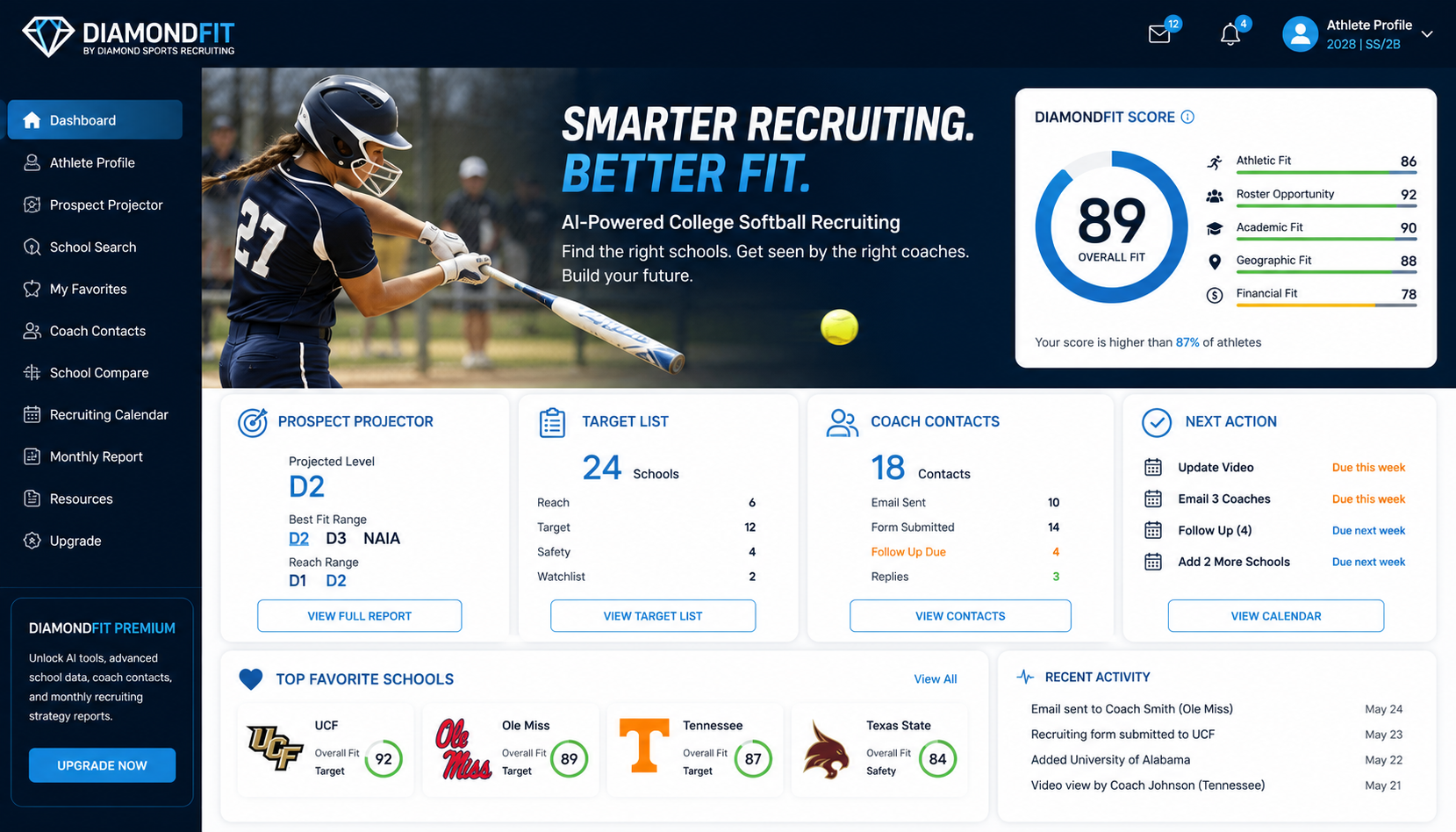
How to get recruited for college softball
The college softball recruiting process can feel confusing because families are trying to answer several questions at once: When should recruiting start? What level fits? Which schools need this position? Which camps are worth it? Which coaches should we contact? DiamondFit was built to help softball families answer those questions with more structure and less guesswork.
Understand the athlete’s level
Before building a college softball target list, families need a realistic view of the athlete’s current fit range, reach range, and development priorities.
Build a realistic school list
A strong softball recruiting list should include reach, target, safety, and watchlist schools based on athletic fit, academics, geography, cost, and roster opportunity.
Turn research into action
Families need a clear plan for recruiting forms, coach emails, camps, showcases, video updates, and follow-ups.
College softball recruiting: 7 proven steps to build the best-fit school list
The best college softball recruiting plan is organized, realistic, and action-based. These seven steps help families move from confusion to a smarter recruiting strategy.
Build the athlete profile
Track sport, graduation year, position, measurables, academics, video links, school preferences, and recruiting goals.
Project the right level
Understand the athlete’s realistic fit range before spending time and money on the wrong schools.
Study roster opportunity
Look at position depth, class balance, upperclassmen, transfers, and possible future roster openings.
Build a balanced target list
Include reach, target, safety, and watchlist schools based on fit instead of name recognition alone.
Create position-specific video
Make it easy for coaches to evaluate the athlete’s defensive actions, offensive profile, arm strength, speed, and game skills.
Contact coaches correctly
Submit recruiting forms, send short school-specific emails, include video, and track follow-ups.
Spend smarter on camps
Use school fit, roster opportunity, and coach contact status before paying for camps or showcases.
The softball recruiting timeline rewards preparation.
Softball families often hear that recruiting starts early, but early does not mean random. The goal is to prepare the athlete profile, build strong video, understand school fit, and focus outreach when the athlete has a clear target list and a strong reason to contact each program.
- Freshman year: learn the process, track metrics, build habits, and start organizing possible schools.
- Sophomore year: update video, evaluate camps carefully, and begin narrowing the target list.
- Junior year: communicate more actively, submit recruiting forms, and prioritize high-fit programs.
- Senior year: manage serious interest, visits, offers, financial fit, and final school decisions.
DiamondFit Timeline Advantage
DiamondFit helps families avoid waiting too long, over-spending too early, or building a softball target list that does not match the athlete’s profile.
D1, D2, D3, NAIA, and JUCO softball recruiting all look different.
One of the biggest mistakes families make is treating every college softball level the same. The right fit depends on the athlete’s current ability, development path, academic goals, budget, geography, desired college experience, and roster opportunity.
| Level | What Families Should Understand | DiamondFit Angle |
|---|---|---|
| D1 Softball | Highly competitive, often fast-moving, and usually requires strong tools, performance, exposure, and program fit. | Use as a reach or target range only when the athlete’s profile and roster opportunity support it. |
| D2 Softball | Strong softball, athletic scholarship possibilities, and a wide range of academic and geographic fits. | Often a strong fit range for athletes with competitive tools and realistic roster opportunity. |
| D3 Softball | No athletic scholarships, but many strong academic and softball programs with excellent college experiences. | Academic fit, admissions profile, cost, and roster opportunity become especially important. |
| NAIA Softball | Can offer strong playing opportunities, scholarships, and competitive programs across many regions. | Good option for athletes who want opportunity, development, and broader school-fit possibilities. |
| JUCO Softball | Can be a development path, academic reset, cost-conscious option, or bridge to four-year programs. | Useful for athletes who need more time, exposure, physical development, or academic positioning. |
Roster fit may be the most overlooked part of softball recruiting.
A school can look perfect on paper but still be a poor recruiting target if the roster is crowded at the athlete’s position. Softball families should look beyond the logo and study position depth, class balance, transfers, upperclassmen, and whether a future roster opening is realistic.
Position Depth
How many players are already listed at the athlete’s primary and secondary positions?
Class Balance
Are those players freshmen and sophomores, or are there upperclassmen who may create future opportunity?
Recruiting Pattern
Does the program recruit similar athletes, regions, positions, or academic profiles?
Are softball camps and showcases worth it?
Softball camps and showcases can be valuable, but only when they fit the athlete’s recruiting plan. The wrong event can waste money, travel time, and energy. The right event can support evaluation, visibility, and coach interaction.
- Is the school a realistic athletic and academic fit?
- Is there possible roster opportunity at the athlete’s position?
- Has the athlete already contacted the coach or submitted the recruiting form?
- Will the camp provide meaningful evaluation or just exposure?
- Does the event align with the athlete’s current recruiting timeline?
Camp Decision Rule
Before paying for a camp, ask whether that school belongs on the athlete’s target list. DiamondFit helps families compare schools before spending more money on events. Premium includes the Camp Evaluator for deeper camp and showcase decisions.
How to email college softball coaches
A strong coach email is short, specific, and relevant. Coaches should quickly understand who the athlete is, why the school fits, what position the athlete plays, what video or metrics are available, and what action the family is requesting.
- Use the coach’s name when possible.
- Include grad year, position, school, travel team, and location.
- Include key metrics and a video link.
- Explain why the school is a fit.
- Submit the recruiting form when available.
- Track follow-up dates and coach responses.
Premium Coach Outreach Workspace
DiamondFit Premium is designed to help families organize coach contacts, use personalized outreach templates, create school-specific drafts, track follow-up dates, and use AI-assisted outreach drafting with athlete profile data and school-fit context.
A softball recruiting video should make evaluation easy.
Coaches do not need over-produced highlight reels. They need clear, useful video that helps them evaluate the athlete. A strong softball recruiting video should match the position and show the skills coaches actually need to see.
Pitchers
Show mechanics, velocity, movement, command, pitch mix, and game or bullpen angles that are easy to evaluate.
Catchers
Show receiving, blocking, throwdowns, pop time, arm strength, footwork, leadership, and hitting.
Infielders
Show ground balls, footwork, hands, range, arm strength, throws across the diamond, and hitting.
Outfielders
Show routes, reads, throws, arm strength, speed, defensive actions, and offensive profile.
Build a smarter college softball recruiting plan with DiamondFit.
DiamondFit helps softball families move from scattered research to a focused recruiting plan. Base gives families the core recruiting foundation: athlete profile, Prospect Projector, limited school search, a five-school starter target list, and basic fit insights. Premium unlocks the full recruiting command center: full school search, full roster intelligence, coach outreach tools, school comparison, monthly report, Camp Evaluator, exports, and the full AI Recruiting Assistant.
Prospect Projector
Project the athlete’s realistic fit range, reach range, strongest tools, development priorities, and recommended next recruiting action.
School Search
Base includes limited school search and up to five recommended or priority schools. Premium unlocks full softball school search and advanced filters.
Premium Coach Outreach
Premium helps organize coach contacts, recruiting questionnaires, official program links, outreach drafts, follow-up dates, and next actions.
College softball recruiting checklist for families
Use this checklist to stay organized as the athlete moves through the softball recruiting process.
Profile & Video
- Create an athlete profile.
- Add position, grad year, school, team, and contact information.
- Upload current video.
- Track verified metrics and update dates.
School List
- Build reach, target, safety, and watchlist schools.
- Review academic fit and major interest.
- Evaluate cost and distance.
- Study roster opportunity by position.
Coach Outreach
- Submit recruiting forms.
- Email the right coach or recruiting coordinator.
- Track responses and follow-ups.
- Update coaches with new video and metrics.
Official college softball recruiting resources
Recruiting rules, calendars, eligibility standards, and scholarship details can change. Families should use DiamondFit for recruiting strategy and school-fit planning, while checking official governing-body resources for current rules and eligibility requirements.
NCAA Recruiting Calendars
Review official NCAA recruiting calendars for current Division I and Division II recruiting periods.
View NCAA CalendarsNCAA Eligibility Center
Use the NCAA Eligibility Center to review academic eligibility and certification requirements.
View Eligibility CenterNFCA Recruiting Resources
Review softball-specific recruiting resources, including links to NCAA softball recruiting information.
View NFCA ResourcesKeep building your recruiting plan.
Softball recruiting is only one part of the larger college recruiting journey. Use these resources to keep learning and build a smarter plan.
DiamondFit
Use athlete profile tools, the Prospect Projector, school search, roster opportunity, and fit scoring to build a better target list.
Learn MoreBaseball Recruiting
Have a baseball athlete too? Learn how baseball recruiting differs from softball.
Baseball GuideResources
Explore recruiting timelines, camp strategy, coach emails, and family checklists.
View ResourcesCollege softball recruiting questions
When should softball recruiting start?
Families can start learning the process, tracking metrics, building video, and researching schools early in high school. Coach communication rules vary by division and calendar, so always check official rules before relying on a specific contact date.
How do I know what level my athlete can play?
Start by comparing the athlete’s position, grad year, metrics, video, academics, and development path against the demands of each level. DiamondFit’s Prospect Projector is designed to help families understand realistic fit ranges.
Are college softball camps worth it?
Camps can be valuable when the school is a strong fit and the athlete is ready to be evaluated. They can be a waste of money when the school is unrealistic, too crowded at the position, or not aligned academically or financially.
What should I send college softball coaches?
A strong coach email usually includes the athlete’s name, grad year, position, school, travel team, location, key metrics, video link, academic information, and a short reason why the school fits.
Do softball scholarships cover everything?
Scholarship amounts vary by school, division, roster needs, academic aid, financial aid, and program resources. Families should compare total cost and financial fit, not just athletic scholarship possibility.
Can DiamondFit guarantee recruiting interest?
No. No recruiting tool can guarantee a coach response, offer, roster spot, scholarship, admissions outcome, financial aid package, or recruiting result. DiamondFit helps families make smarter decisions, build better target lists, and organize the recruiting process.
